Italian Gestures: The Parallel Language Your Textbook Never Taught You
In 2011, researchers at the University of Chicago confirmed what every Italian already knew: Italian gestures are not decoration. They are a genuine linguistic system. Not random movement — a precise non-verbal vocabulary with its own grammar, its own regional dialects, and its own history stretching back to ancient Rome. You can have a complete conversation in Italian without saying a single word. Learning Italian without learning the gestures is like watching a film with the sound off. Here are the ones you need.
Italian gesture culture has its deepest roots in southern Italy — Napoli in particular — where gestures developed as a form of communication in crowded, noisy environments and, more importantly, during centuries of foreign occupation when speaking too openly could be dangerous. Gesture became a way to say what words could not. Today the tradition is used across the whole country, though the intensity varies considerably: a Neapolitan gestures constantly and dramatically, a Venetian uses gesture sparingly, a Sicilian has moves that nobody from the north will fully recognise.
🤌 The essential gestures and their vocabulary
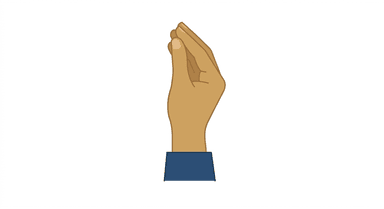
All five fingers touching, hand shaking upward. The most famous Italian gesture in the world. Became an emoji: 🤌
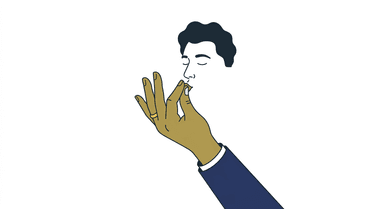
Chef's kiss! Touch fingers to lips then open. For when something is absolutely perfect.

Back of hand flicked outward from under chin. A gesture of complete indifference.
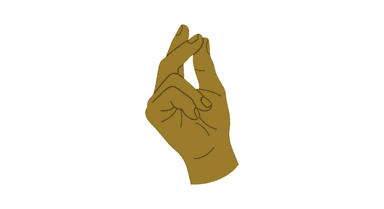
Thumb rubbing against index and middle fingers. Universal money gesture, very Italian.
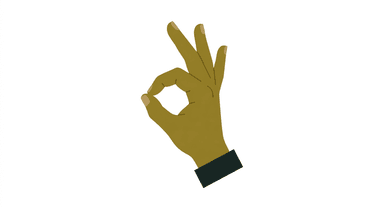
Thumb and index finger forming a circle, other fingers extended. Agreement, approval.
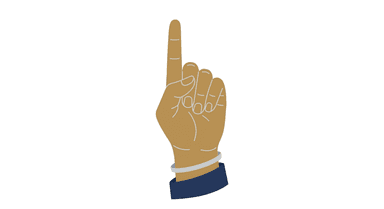
One finger raised, often with a stern look. 'Hold on a moment.'
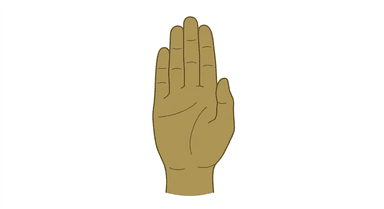
Flat hand pushed forward, palm out. Stop. Enough. No more.
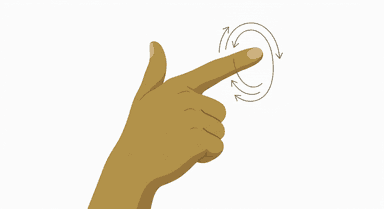
Index finger pointing and rotating near the temple. 'Are you out of your mind?'
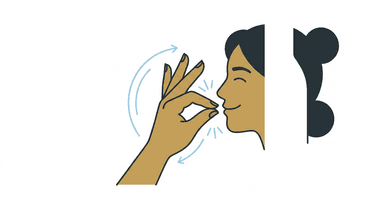
Fingers pinched together moving toward mouth. Can mean hunger or that food is amazing.
Index finger pulls down lower eyelid. 'I see what you're doing, clever one.'
Index finger vertical on lips. Same as English, but Italians mean it more.
Gestures in Italy are regional. A Neapolitan gestures constantly and emphatically. A Milanese is more restrained. A Roman uses gesture as punctuation. A Sicilian has specific moves nobody from the north will recognise. When in doubt, just 🤌 and you'll be understood everywhere — it has become the universal symbol of Italian-ness worldwide.
🗣️ Expressions that go with gestures
Said with hands on cheeks or raised to the sky. Means everything and nothing.
One word, infinite meanings depending on the gesture and tone.
Shoulders up, hands out — the Italian shrug. Very philosophical.
Disbelief, surprise, mild annoyance — very useful.
Hand palm-up, impatient look. 'Yes, and? What's your point?'
⚠️ Gestures to use with caution
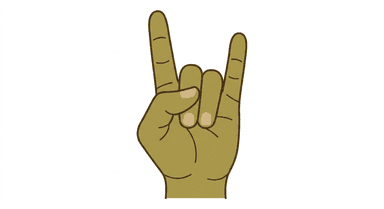
Be careful: this gesture means either warding off bad luck OR calling someone a cuckold. Context is everything. Pointing it at someone is an insult.
One hand hitting the crook of the other arm. Emphatically rude. Don't use it unless you know what you're doing.
Gesture and word combinations
Che vuoi? (fingers pinched, hand raised)
What do you want? / What are you talking about?
Perfetto! (chef's kiss) — La pasta è ottima!
Perfect! — The pasta is excellent!
Soldi, soldi! (finger rub) — Costa troppo.
Money, money! — It costs too much.
Boh... (shrug) non lo so davvero.
No idea... I genuinely don't know.
The most scholarly account of Italian gestures comes from an 1832 book by Canon Andrea de Jorio: <em>La mimica degli antichi investigata nel gestire napoletano</em> (The mime of the ancients explored through Neapolitan gesture). De Jorio catalogued hundreds of Neapolitan gestures and compared them to figures on ancient Greek vases — arguing that the gestures had survived essentially unchanged for two thousand years. <strong>Modern linguists largely agree.</strong> Italian gesture culture is ancient, systematic, and genuinely worth learning — not as a curiosity, but as a living part of the language.
2,500+ free exercises are waiting for you.
Start practising free →