Alberobello: The Town That Looks Like a Fairy Tale (And Has a Criminal Origin Story)
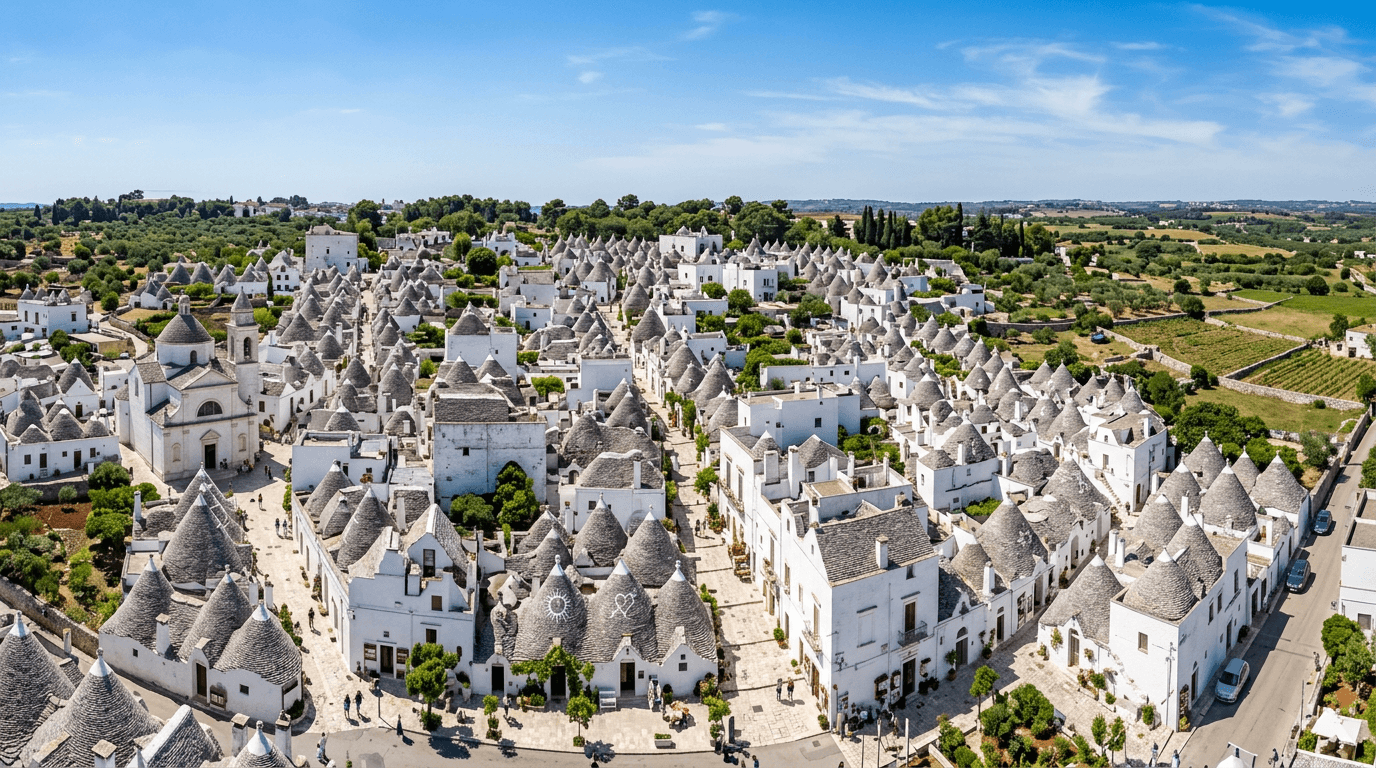
Imagine a hillside covered in hundreds of white stone cones. No straight lines. No right angles. No mortar holding anything together. That is Alberobello, a small town in Puglia that looks like it was designed by someone who had never seen a normal house — and didn't want to.
The houses are called trulli (singular: trullo). They are circular at the base, with thick limestone walls and a conical roof made of flat stones stacked on top of each other without a single drop of cement. Many are painted with mysterious symbols — stars, crosses, spirals, hearts — whose meaning historians still debate. The overall effect is somewhere between a medieval village and a Salvador Dalí painting.
And here is the part that nobody tells you: these houses exist because of a tax scam.
In the 17th century, the feudal lord of the area — Count Acquaviva — wanted to populate his land but couldn't build permanent settlements without royal permission, which came with heavy taxes. His solution? He ordered the peasants to build without mortar, so that every house could be quickly demolished before a royal inspector arrived. When the inspector left, the roofs went back up. This went on for decades. The trulli survived the inspectors, the feudal system, the Kingdom of Naples, and five centuries of Italian history. In 1996, UNESCO gave them World Heritage status.
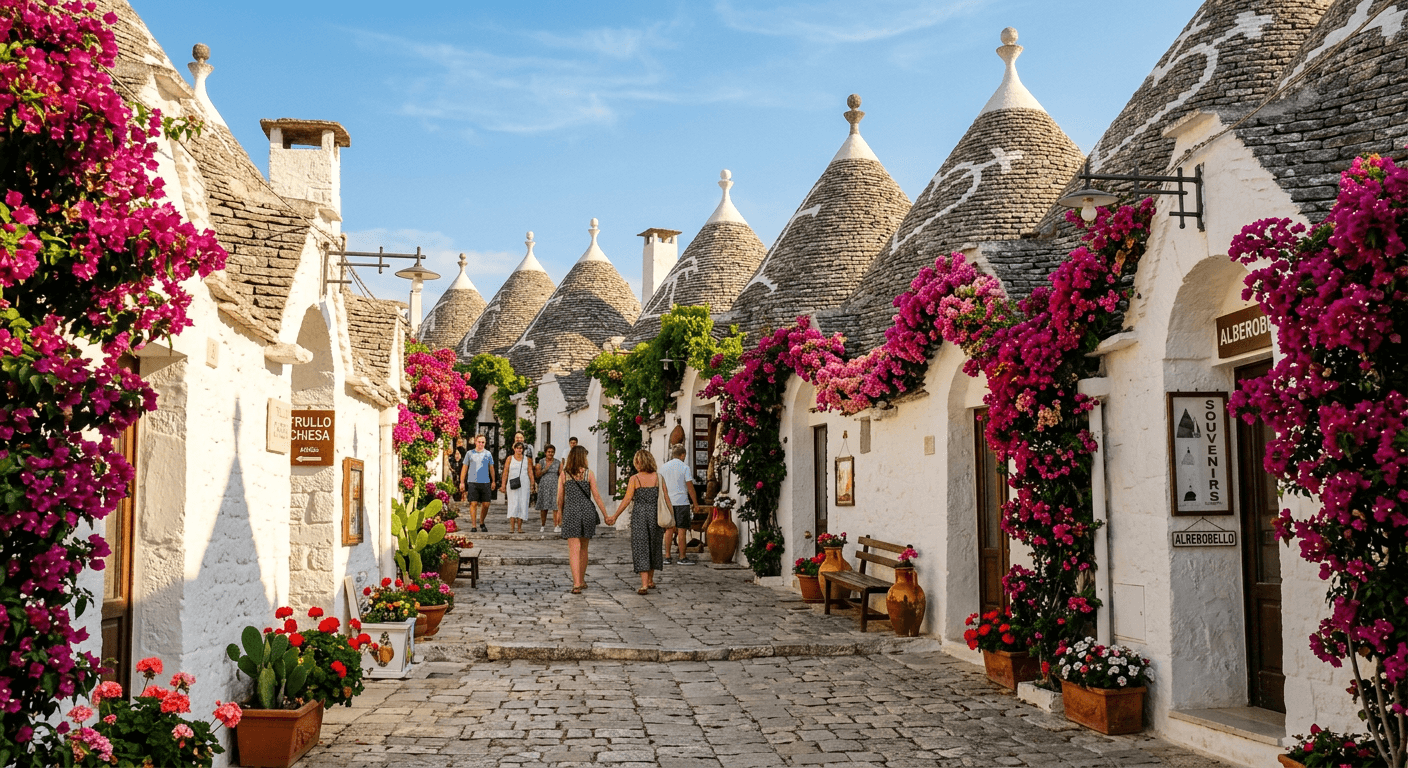
Walking through the Rione Monti district — the heart of Alberobello — is a genuinely disorienting experience. The streets are narrow. The buildings are low. Everything is white and grey. And then you look up and realise the skyline is made entirely of cones. Hundreds of them, one after another, up the hill. It is the kind of view that makes you stop mid-step.
What most tourists miss is the Rione Aia Piccola, just across the road. Less visited, less commercial — and far more authentic. Here, many trulli are still privately inhabited. You won't find souvenir shops. You'll find old women hanging laundry between the cones, and cats sleeping in the doorways. This is the real Alberobello.
If you want to go one step further: spend the night inside a trullo. Dozens have been converted into B&Bs. The walls are over a metre thick — keeping it cool in summer and warm in winter. The rounded ceiling creates a strange acoustic. Voices sound different inside, softer and more intimate. It is hard to explain, but sleeping in a trullo changes how you feel about the building. You stop seeing a tourist attraction and start feeling a home.
🇮🇹 Italian vocabulary from this place
I trulli sono costruiti senza malta. — The trulli are built without mortar.
La tecnica della pietra a secco è antichissima. — The dry-stone technique is very ancient.
Ogni trullo ha un pinnacolo diverso. — Every trullo has a different pinnacle.
Il Rione Monti è il quartiere più famoso. — The Rione Monti is the most famous neighbourhood.
Il feudatario ordinò di costruire senza malta. — The feudal lord ordered them to build without mortar.
Molti trulli hanno simboli misteriosi dipinti sui tetti. — Many trulli have mysterious symbols painted on the roofs.
Alberobello è patrimonio UNESCO dal 1996. — Alberobello has been a UNESCO site since 1996.
Il paese è davvero affascinante. — The town is truly charming.
Alberobello is in Puglia, about 65 km south of Bari. Take the Ferrovie del Sud-Est train from Bari (about 1.5 hours, very cheap). Go in May or October — perfect temperatures, fewer crowds, and the bougainvillea is in full bloom. Combine with nearby towns: Locorotondo, Martina Franca, and Ostuni are all within 30 minutes by car and just as beautiful. Stay at least one night — ideally inside a trullo.
How to talk about it in Italian
Alberobello si trova in Puglia, nel sud Italia.
Alberobello is in Puglia, in southern Italy.
I trulli sono costruiti con pietre calcaree sovrapposte senza cemento.
The trulli are built with layered limestone stones without cement.
Si può dormire dentro un trullo trasformato in bed and breakfast.
You can sleep inside a trullo converted into a bed and breakfast.
Il paese è stato dichiarato Patrimonio dell'Umanità dall'UNESCO nel 1996.
The town was declared a UNESCO World Heritage Site in 1996.
I simboli dipinti sui tetti sono ancora oggetto di dibattito tra gli storici.
The symbols painted on the roofs are still debated among historians.
Learning Italian? These places make a lot more sense when you speak the language.
Start learning free →